A guide for people who have just arrived: five texts, one set of codes, what is settled, what is not, and where the name comes from.
Every few weeks someone finds this blog through the family-tree posts and writes to ask the same three questions. What is this script? Where does it come from? And why has nobody just read it yet? I keep answering by email, at length, which is a silly way to run a blog. So here is the answer in one place, written for people who have never seen a Kristiansen code and would like to know what the fuss is about before they wade into a fourteen-page paper on Hidden Markov Models.
I am not an academic. I trained as a librarian and have spent most of my working life looking after other people’s archives; the linguistics, the code-breaking and the genealogy are hobbies that got out of hand. That is worth saying up front, because the honest summary of this field is that a handful of careful people have established a few things very firmly, guessed at a few more, and admitted in print that they cannot rule out the whole thing being a prank. I find that admirable rather than discouraging. It is, after all, what the tagline of this blog says.
What we actually have
We have less material than people expect.
Everything arrived as drawings, prints and transcriptions. Not one physical object has been examined by anyone who has published on it. The images and text files were sent by anonymous email to Jan-Tage Kristiansen in 2023 and later, in the same way, to the other researchers. Nobody knows who sends them.
What arrived, in order of publication:
- The scapula (KS-01). Three renderings of the same drawing (an “original”, a print, and a photocopy of the print) of a shoulder blade with four short ruled lines of angular signs on it. Each line holds two groups; each group ends in a slash. Thirty-one distinct signs, each one exactly once. This is the text everything else hangs on.
- A longer companion inscription. Six lines, 146 signs, supplied as a transcription only. We do not know what it was written on. It uses a subset of the scapula’s signs.
- The Dozenal Primer. Forty-five short clauses, again supplied as line drawings and transcription. Named after what Ginevra Rubergskier thinks it is (more below).
- Three extended inscriptions. The longest running texts we have, published as vector tracings by Camille Voudrin’s group. Unlike the primer, they do not look like sums.
- The Zagi Tablets. Four clay tablets, 104 short sentences, headed in Akkadian imri Zagi-ak, “the clan of Zagi”. These are the odd ones out: the same signs, but scratched into clay in a cuneiform setting rather than cut into bone, and the only text with a heading anyone can actually read. They are also my own patch of the field.
The one thing everyone agrees on: the codes
If you read anything in this field you will meet strings like C01-M03-S01-C02. These are Kristiansen codes, and they are the reason the field can talk to itself at all.
In his 2023 note Kristiansen did something very simple and very disciplined. He looked at the thirty-one signs on the scapula, sorted them into eight visual families (corners, boxes, triangles, lines, tees, combs, meanders and barred posts), gave each family a letter and each member a number, and reserved P01 for the slash. He did not say what any sign meant or sounded like. He still hasn’t. He describes his job as “keeping the inventory honest”, and every later study, whatever it argues, uses his codes unchanged.
The scapula itself turned out to be the best possible starting point: it lists every sign once, family by family, in order. It is, in other words, a sign list. Whether you want to call it an abecedary depends on whether you think the signs are letters, and that is the whole question.
What we think we know
Here is my ranking, from most to least secure. Reasonable people will shuffle the middle of this list.
1. The slash is punctuation. P01 appears at the end of the groups on the scapula, at the end of clauses in the primer, and at the end of sentences on the Zagi tablets. It never appears in the middle of anything. Nobody disputes this.
2. The signs split into two classes that behave like vowels and consonants. This is Voudrin, Marchand and Leclerc (2024). They fed the three extended inscriptions into a two-state model with almost no assumptions (no three vowels in a row, no four consonants in a row, at least one vowel per word) and practically every sign landed hard at one end or the other. Better still, the split follows Kristiansen’s visual families exactly: corners, boxes, triangles and combs behave like consonants; tees, lines, meanders and barred posts behave like vowels. Not one family is mixed. The commonest word shapes come out as CVC and CV, consonant clusters obey the usual sonority rules, and one sign, C05, sits at the front of clusters the way an s does. The authors are careful to say this is not a decipherment. But it is the strongest structural result we have, and it is why I allow myself to write these words with letters at all.
3. The Dozenal Primer is a primer for base-twelve arithmetic. Rubergskier (2024) argued this from distribution alone: a bound clause-final slash, an invariant four-sign sequence in the middle of every equation-like clause (she reads it as “equals”), a tight two-sign cluster that behaves like “plus”, another that behaves like “minus”, a simplex unit that behaves like “one”, and a four-sign bundle glued to the right edge of numerals that multiplies by twelve. The clincher is that “eleven plus one”, “ten plus two”, “nine plus three” and “six plus six” all land on the same suffixed result. That is what twelve looks like when you do not know the number names. The text goes on to a gross (twelve twelves) and, in one clause, a great-gross. I found this paper through a popular-science digest, and it is what got me into all this. Voudrin’s group and Rubergskier agree, in print, that their results describe different levels of the same object: the primer may well be sums written in a language that has ordinary syllables.
4. The Zagi Tablets are a family tree. Inrik Üksküla’s preprint laid out the structure: two pivot signs, a small paradigm of four markers he glossed ONE to FOUR, a “unit” sign that always sits next to them, and a linker he called AND_PLUS, which turns out to be Rubergskier’s “plus” exactly. He offered two readings, an arithmetic drill and a genealogical primer, and stayed on the fence with a lean towards a hybrid. My two posts (March and April 2024) argued that if you let his UNIT be the ordinary word CHILD, his definitional pivot be HAVE and his equational pivot be BE, the tablets stop being algebra and start being the most ordinary sentences in the world: “X has two children. Child one is Y. Child two is Z.” From there, and from the way the same short words recur with two different endings, I got a gender-neutral word for child and one for parent, a gendered pair of each (I cannot tell you which ending is which sex), a little word that behaves like “of”, and a consistent three-generation family with a pair of grandparents on each side. I still think that reading is right. I also still think two lines in Document 3 are copying errors, because the alternative is that the same word means “child” everywhere except in exactly those two sentences.
5. The texts belong to one system. The Zagi tablets use the same “plus” as the primer and the same numerals ONE to FOUR. The primer and the extended inscriptions use the same signs with the same vowel-consonant behaviour. Whether they come from the same hand, place or century is another matter, but they are not five unrelated puzzles.
What we do not know
No object. We have drawings of a shoulder blade and transcriptions of everything else. Kristiansen, who has spent more time with the scapula images than anyone, will say only that the three renderings clearly copy one original drawing, and that a modern pastiche cannot be excluded. Until someone produces a bone, a tracing made under raking light, or even a museum number, everything on this blog is the analysis of a rumour.
No date and no place. The Zagi tablets, being clay with an Akkadian heading, are the only text with any cultural anchor at all, and even there the heading looks like a label stuck on when the tablets entered a cuneiform scribal setting, not a translation of what is on them. How a text in these signs ended up in that setting is a question nobody has tried to answer in print.
The Yedoma Ledger. In 2021 a team led by J. Levi Schültke recovered a plaque of mammoth ivory with ruled, incised registers from thawing permafrost in the lower Indigirka basin in northeast Siberia. Their report is descriptive and published one photograph. Since 2024 people have quietly wondered whether Kristiansen’s six-line companion inscription, which came with no indication of what it was written on, might be a transcription of that plaque: the timing fits, the size fits, the stroke repertoire fits, and there is no other candidate. Nobody has compared a single sign. Schültke has never commented. Kristiansen, asked directly, said he had “no basis for saying so and no basis for denying it”. I put it here, under things we do not know, and I would ask you to leave it there too.
No sounds. This one trips up newcomers most, because the posts on this blog are full of words like séš and mêgi and tnupôv. Those letters are mine. I assigned them by frequency, with a script, purely so that I could read the sentences without my eyes glazing over at a row of codes; the only real content in them is which signs are vowels and which are consonants (Voudrin) and the rule of one sign, one sound. There is not a single sign in this corpus whose pronunciation anyone claims to know.
No language. The vowel-consonant split tells us the signs spell syllables. It does not tell us whose. There is no bilingual, and the Akkadian heading on the Zagi tablets does not translate the glyphs beneath it.
Whether it is all one thing. Same signs, same slash, same “plus”. But the primer looks like sums and the extended inscriptions do not; the tablets are clay and the rest is bone or unknown. One system, several genres? Several scribes, one tradition? A modern hoaxer with a good sense of typology? All still open.
The lines I would not read. Document 1 of the Zagi tablets opens, and Document 4 closes, with two short sentences containing nothing I could pin down: in my letters, ka BE séš and tnav BE ma OF séš. Everyone who reads my second post wants them to say “I am Séš. This is the family of Séš.”
Who sends the emails. Three years on, still nobody knows.
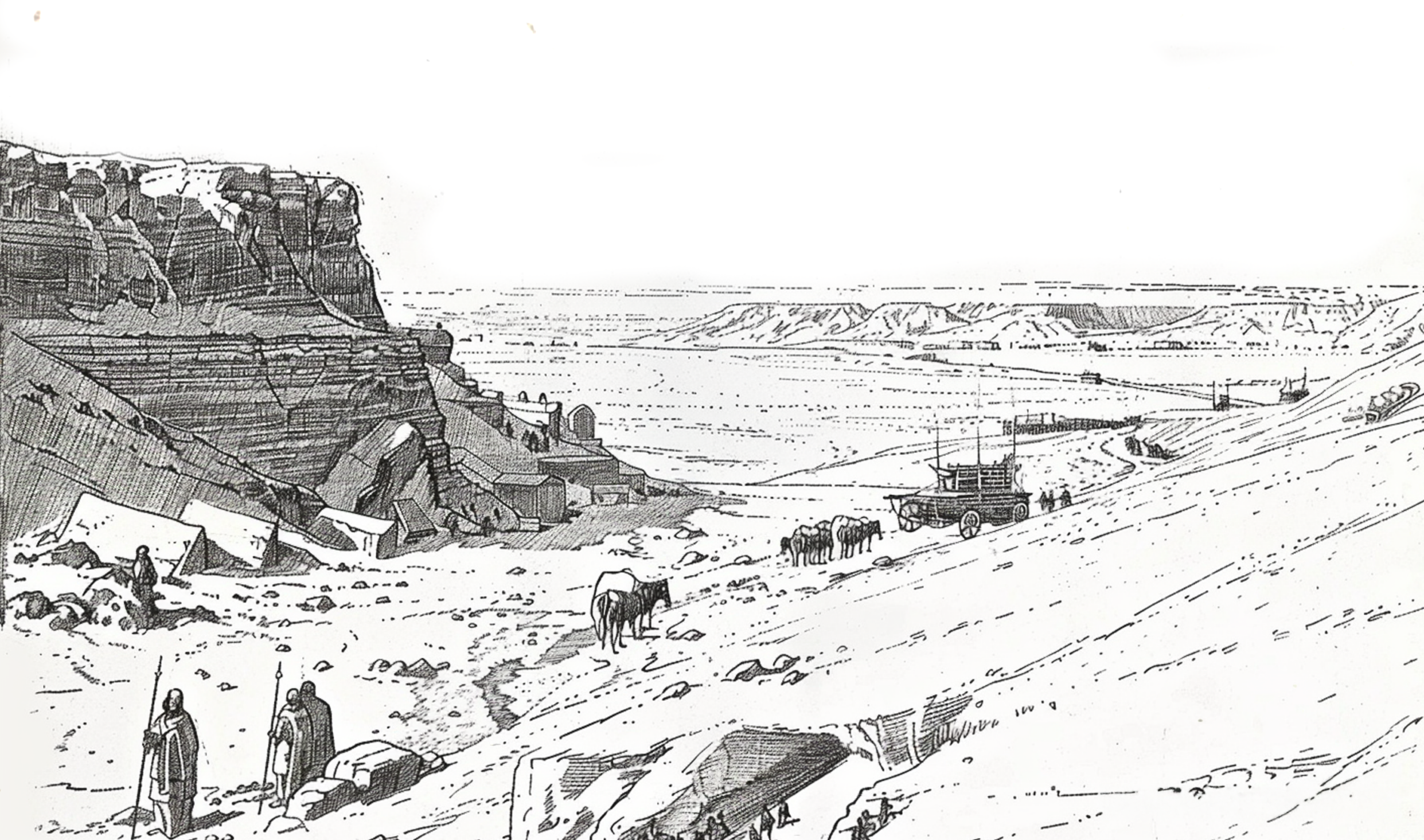
Where the name comes from, since people ask. There is a 1938 article by H. Weidner in the Mitteilungen der Deutschen Orient-Gesellschaft presenting a Sumerian travel account, preserved on an Old Babylonian school tablet, of a royal expedition that went north over the Zagros and the Iranian plateau into a land of snow, a frozen river, endless forest and lights in the sky. In February 2024, before I had written a word here, I went looking in the old Assyriological literature for anything that put a literate Mesopotamian anywhere near the region the Ledger came out of, and found that article, and then, in an incomplete run of the same series, a short addendum from 1939 that nobody seems to have cited since the war. It gives the last lines of the tablet. In one of them the people at “the head of the lands” tell the expedition what they call their own tongue: ki-li-ma, which the interpreter glossed as “the living tongue”. I took it for the name of this blog and said so only on the About page. Let me be exact about what that line does and does not do. It names a language spoken somewhere in the northern forests around 2100 BC. It does not say that language was written; the scribe says the opposite, that it was “a tongue Nisaba does not know”. Nothing connects the people he met to the people who cut these signs except a very large region and a hunch. So “Klema” is a name of the Hittite type: given for the wrong reasons, by the first person who needed one, and probably here to stay. It is a better name than “the Kristiansen corpus”. That is all I claim for it.
If you are new, read these first
In this order:
- Kristiansen, “Twin renderings, single template: a ruled signary on a putative cervid scapula” (language 27, October 2023).
- Rubergskier, “A dozenal primer hidden in plain sight” (Language Codes 6, 2024). Five pages, and the best introduction to how people reason about these texts without a key.
- Voudrin, Marchand and Leclerc, “A distributional test of vowel–consonant structure in an undeciphered signary” (Language Codes 7, 2024). Long and technical, and worth it; skip the pseudocode on a first pass.
- Üksküla, “The Clan of Zagi: Numeric Calculus or Genealogical Primer?” (preprint, 2024). His materials are downloadable, and you can redo my analyses yourself in an afternoon.
- Then my two posts, The Zagi Family and Who’s who in the Zagi family?, which are probably the reason you are here.
Kristiansen’s longer working paper on the scapula and the companion inscription, Schültke’s 2021 report on the Ledger, and Weidner’s 1938 article with its 1939 addendum are for the second week.
Timeline
- 2021. Schültke’s team recovers the Yedoma Ledger from permafrost; a preliminary report circulates.
- 2023. Anonymous emails bring the scapula drawings and a longer transcription to Kristiansen. In October his correspondence note introduces the codes; later that year, his longer working paper.
- Early 2024. Rubergskier’s dozenal primer paper (January online, February in print). Üksküla’s Zagi preprint begins to circulate. In February I find Weidner’s 1939 addendum and this blog gets its name.
- March 2024. Voudrin, Marchand and Leclerc’s vowel–consonant study. This blog’s first Zagi post.
- April 2024. Second Zagi post: the family tree.
- Later 2024. Informal talk begins linking the Ledger to the companion inscription. Nobody puts it in print.
- Since then. No new texts. No object. No tracing of the Ledger.
What would change things
Any one of these would move the field further than another year of statistics:
- A tracing of the Ledger’s registers, or a photograph good enough to count signs.
- A text in a different genre: a list, a letter, anything that is not a primer.
- A second heading, on any tablet, that is not imri Zagi-ak.
- An object. Any object.
Until then, this is what we have: a sign list, a sum book, three long texts that scan like language, one family whose tree we can draw but whose names we cannot pronounce, and a name for the whole thing that a Sumerian scribe wrote down four thousand years ago for reasons of his own.
Leave a Reply